Private security for events in hospitality: from operations to board-level risk
Private security for events in hospitality has shifted from an operational concern to a strategic risk lever. For risk managers and directions générales, every large event, private event or special event now concentrates physical threats, cyber exposure and liability in a single venue. The hospitality group that treats each security operation as a one-off project will miss systemic weaknesses in its global protection strategy.
Hospitality events bring together guests, executives, suppliers and security personnel in dense, time-bound environments. This concentration means that security services, catering, ticketing, Wi-Fi and payment systems are tightly coupled, so a failure in one area can cascade rapidly across the entire event. When security guards, event staff and IT officers work in silos, crowd control, access control and emergency response become fragile exactly when they must be robust.
For insurers and juristes, this convergence changes how protection, liability and evidence must be documented. Underwriters now examine whether trained security officers and guards are integrated into enterprise risk management, not just contracted as a last-minute guard service. Claims teams will scrutinise whether the security team followed a documented security plan for the venue, including pre-event risk assessment, real-time control of flows and post-event evaluation.
Why private security for events has become a board level hospitality issue
Event security in hospitality used to be purchased as a commodity service, focused on visible guards and basic crowd control. That approach no longer satisfies the expectations of global brands, regulators or the security companies that provide highly trained officers for complex events. Today, private security for events must be framed as an asset that protects brand equity, revenue streams and long-term peace of mind for boards and investors.
Risk managers who treat security guard contracts as interchangeable will struggle to align them with group-level risk appetite. Instead, they need to evaluate security services as they would any critical supplier, assessing governance, training, cyber posture and incident reporting maturity. This shift allows security personnel and security officers to be measured against clear KPIs that link directly to safety outcomes and legal defensibility.
For special events that mix VIPs, media and international guests, the quality of guard services and the cohesion of the security team become reputational differentiators. A single poorly managed security incident can generate viral content, regulatory scrutiny and complex litigation across multiple jurisdictions. By contrast, a well-governed private event with trained security and clear control of access points reinforces trust among partners, insurers and regulators.
Designing an integrated security plan for complex hospitality events
Designing an integrated security plan for hospitality events starts long before the first guest arrives at the venue. The dataset for private security for events highlights a simple but powerful timeline: pre-event planning, event execution and post-event evaluation. Each phase requires a different configuration of security guards, technology, crowd control measures and legal documentation.
During pre-event planning, risk managers should lead a structured risk assessment that covers physical layouts, cyber dependencies and local regulatory constraints. This assessment must map how guests, staff, suppliers and security personnel will move through the venue, identifying choke points where crowd control and access control will be critical. Security officers and guards should participate in these walkthroughs so that the eventual security team understands blind spots, emergency exits and the specific protection needs of VIPs or vulnerable guests.
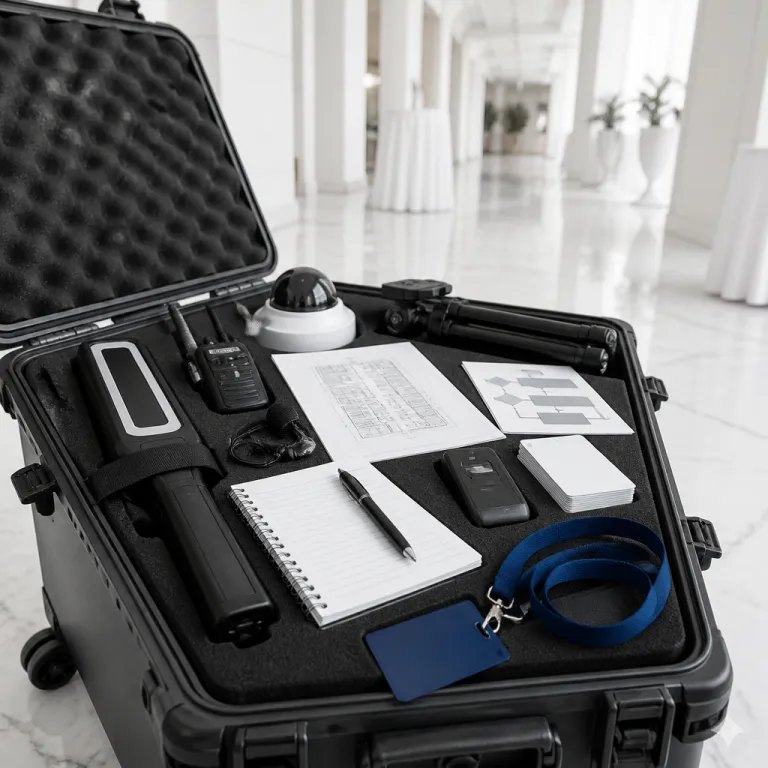
Event execution is where the quality of trained security and guard services becomes visible. Security services should deploy layered access control, combining credential checks, metal detectors and CCTV cameras to maintain a safe perimeter without degrading the guest experience. Security guards and each security officer must coordinate with event staff, local law enforcement and emergency services through reliable communication devices to ensure rapid emergency response if a security event escalates.
From crowd control to converged risk governance
Post-event evaluation is often neglected, yet it is where organisations transform isolated events into institutional learning. Every special event or private event should generate a short, structured report from the security team, documenting incidents, near misses and deviations from the security plan. These reports allow insurers, juristes and risk managers to refine future security services and to evidence due diligence if litigation arises.
For readers seeking a deeper framework on this evolution, the perspective on rethinking event security for hospitality from crowd control to converged risk governance is particularly relevant. It shows how security personnel, IT officers and legal teams can align around shared risk scenarios rather than isolated checklists. In practice, this means that security guards, cyber teams and operations managers will rehearse joint emergency response drills, using realistic scenarios that combine physical intrusion, data compromise and guest safety challenges.
When events are treated as part of a converged risk programme, private security for events stops being a reactive cost centre. Instead, security services become a structured service line that protects revenue, reduces insurance friction and strengthens peace of mind for boards and investors. Over time, this approach builds a culture where every guard, officer and manager understands that event security is a shared responsibility, not a task outsourced to a single guard service.
Aligning private event protection with executive and cyber risk
Hospitality events increasingly combine executive presence, sensitive data and complex logistics, which means that private security for events must align with executive protection and cyber security. A gala dinner, roadshow or investor summit is no longer just a special event; it is a live concentration of strategic information, high-profile guests and operational dependencies. Security personnel who focus only on visible threats at the venue will miss the more subtle risks that arise from social engineering, open Wi-Fi and unsecured back-of-house areas.
Risk managers should treat each private event as a temporary extension of the corporate perimeter. That means integrating security guards and security officers into protocols for protecting mobile devices, confidential documents and executive movements between hotel, airport and event site. When guard services are briefed on executive protection objectives, they can coordinate with drivers, personal assistants and IT teams to maintain a safe and discreet security envelope around key individuals.
For directions générales, aligning event security with executive risk is also a governance question. Boards expect that highly trained security personnel will not only manage crowd control and access control, but also support cyber hygiene by monitoring for suspicious behaviour around registration desks, payment terminals and backstage networks. The most effective security team treats every security event as an opportunity to reinforce security culture among staff and guests, rather than as a narrow physical protection task.
Building a unified protection ecosystem
Hospitality groups that operate across multiple countries need a unified approach to private security for events, executive protection and cyber resilience. One practical path is to align event security playbooks with the organisation’s broader executive protection strategies, such as those explored in this analysis of executive protection strategies for hospitality leaders. This alignment ensures that security guards, security officers and cyber teams share common threat models and escalation paths.
In concrete terms, this means that trained security at a special event will know how to respond if a phishing attempt targets the registration desk or if an unauthorised person tries to access a restricted digital control room. Guard service supervisors should participate in cyber incident tabletop exercises, so that emergency response procedures account for both physical and digital containment. When a security plan integrates these dimensions, guests experience a safe environment, while insurers and juristes gain confidence that the organisation can manage complex, multi-vector incidents.
For private events that host C-suite leaders or politically exposed persons, the stakes are even higher. Security services must coordinate with local law enforcement, diplomatic protection units and internal legal teams to ensure that guards and officers understand jurisdictional constraints and duty of care obligations. This unified ecosystem transforms the security team from a reactive presence into a proactive shield that protects people, information and brand reputation across the entire event lifecycle.
Operationalising trained security and technology at the venue
Translating strategy into reality at the venue requires disciplined operational design for private security for events. The dataset underlines three core methods: risk assessment, access control and surveillance, all of which must be adapted to the specific event, venue layout and guest profile. Security personnel should arrive early for security checks, test communication devices and walk the site to validate that the theoretical security plan matches on-the-ground conditions.
At check-in points, security guards and security officers should apply layered access control that balances safety with hospitality. Metal detectors, bag checks and credential verification can be combined with clear signage and courteous communication, so that guests feel both safe and welcomed. When guards are highly trained in customer service as well as threat detection, they can de-escalate tensions, maintain crowd control and protect the brand’s image while enforcing necessary rules.
Inside the venue, the security team must maintain dynamic situational awareness. CCTV cameras, patrol routes and discreet observation posts allow security services to monitor crowd density, identify emerging risks and coordinate rapid emergency response if needed. Guard services should use simple, rehearsed codes over radios so that any security guard or officer can trigger a structured response without creating panic among guests or staff.
Integrating innovation without losing human judgment
The global event security market, estimated at 9.1 billion USD according to Statista, is being reshaped by AI-assisted surveillance and advanced analytics. For hospitality risk managers, the challenge is to integrate these tools into private security for events without undermining human judgment or privacy obligations. AI can help security personnel detect unusual crowd patterns or unattended objects, but guards and officers must always make the final decision on intervention.
Security companies that serve hospitality clients should invest in continuous training so that their security team understands both the capabilities and limits of new technologies. Trained security officers need to know how to interpret alerts, manage false positives and document decisions in a way that supports later legal review. When technology is framed as an aid to human expertise, not a replacement, event security becomes more precise, and peace of mind increases for organisers, insurers and guests.
For special events that span multiple days or locations, such as festivals or brand roadshows, the combination of mobile surveillance units, body-worn cameras and centralised command posts can significantly enhance protection. However, juristes must ensure that data retention, consent and cross-border transfer rules are respected, especially when guests travel from multiple jurisdictions. A mature security plan will therefore include clear policies on data handling, ensuring that the benefits of innovation do not create new compliance risks for the organisation.
Legal, insurance and liability dimensions of event security
For insurers and legal teams, private security for events is primarily a question of duty of care, foreseeability and documentation. When an incident occurs at a hospitality venue, investigators will ask whether the security services in place were proportionate to the known risks of that specific event. They will also examine whether security guards, officers and other security personnel were properly trained, supervised and briefed on the security plan.
Policy wording for event security often hinges on how responsibilities are allocated between the organiser, the venue and the security company. Risk managers should ensure that contracts with guard services clearly define roles for crowd control, access control, emergency response and incident reporting. This clarity protects both the hospitality operator and the security team, reducing disputes over whether a particular guard or officer acted within their mandate.
From a liability perspective, the quality of trained security can significantly influence claim outcomes. Courts and regulators will look at whether the organisation selected a reputable provider of security services, verified qualifications and maintained appropriate supervision during the event. When a private event or series of special events is supported by a coherent security plan, documented drills and post-event reports, the organisation can demonstrate that it took reasonable steps to keep guests and staff safe.
Evidence, governance and peace of mind for stakeholders
Documentation is the bridge between operational security and legal defensibility. Incident logs, CCTV footage, radio transcripts and debriefing notes from the security team all contribute to a robust evidential record. These materials help insurers assess claims more quickly and allow juristes to reconstruct the sequence of decisions taken by each security guard, officer and supervisor.
Hospitality groups should embed event security into their broader governance frameworks, including risk committees and internal audit. Regular reviews of guard service performance, training records and incident statistics can reveal patterns that require strategic action, such as redesigning venue layouts or updating emergency response protocols. This governance lens also supports more accurate insurance underwriting, as carriers gain confidence that private security for events is managed systematically rather than reactively.
Ultimately, the goal is to provide genuine peace of mind for boards, investors and guests. When security personnel are highly trained, contracts are clear and evidence is well preserved, all parties can engage in events with greater confidence. As one concise definition reminds us: “What is event security? Measures to ensure safety at events.”, and that simplicity should guide complex legal and insurance structures back to their core purpose.
Embedding event security into hospitality culture and guest experience
Private security for events in hospitality cannot succeed if it is perceived as an external imposition rather than part of the brand’s culture. Guests judge their experience not only by décor and cuisine, but also by how safe and respected they feel throughout the event. Security guards, officers and other security personnel therefore act as both protectors and ambassadors of the brand.
Training programmes for security services should include modules on cultural sensitivity, non-discriminatory practices and communication with guests who may be anxious or unfamiliar with security procedures. When guards and officers explain access control or bag checks with clarity and respect, they transform potential friction into reassurance. This approach is particularly important for international events, where expectations around visible security and crowd control can vary widely between cultures.
Hospitality leaders can also use events as opportunities to reinforce internal security culture. Briefings before a special event or private event should bring together the security team, front office, food and beverage and IT staff to align on the security plan and emergency response roles. Articles such as this analysis of how food safety traditions reshape hospitality risk show how operational disciplines can become part of a shared narrative rather than isolated checklists.
From isolated events to continuous improvement
Each security event, whether minor or major, should feed into a continuous improvement loop. Post-event debriefs that include security guards, security officers, managers and legal representatives help identify what worked, what failed and where trained security needs reinforcement. Over time, this practice builds a living library of scenarios that can be used to train new members of the security team and to refine guard service contracts.
For multi-property hospitality groups, sharing lessons learned across venues and countries is essential. A crowd control innovation tested at one venue, such as redesigned queuing systems or clearer signage, can be replicated at other sites hosting special events. Similarly, improvements in emergency response coordination with local law enforcement or medical services can be standardised across the portfolio, raising the baseline of safety for all guests.
When private security for events is embedded into culture, governance and daily practice, it ceases to be a last-minute concern. Instead, security services, guard services and event security planning become integral to how the brand defines quality and responsibility. The result is a hospitality ecosystem where guests feel safe, staff feel supported and boards can host ambitious events with genuine peace of mind.
Key figures and market signals for event security in hospitality
- The global event security market size is estimated at 9.1 billion USD according to Statista, reflecting strong demand for professional security services at events of all types.
- Industry analyses indicate that AI-supported surveillance and analytics are among the fastest growing segments within event security, as operators seek to enhance crowd control and emergency response without increasing headcount.
- Risk surveys from major insurers show that large-scale events in hospitality are now classified alongside cyber incidents and supply chain disruption as top-tier operational risks, which elevates the importance of a documented security plan and trained security personnel.
- Best practice frameworks emphasise a three-phase lifecycle for private security for events: pre-event planning, event execution and post-event evaluation, which aligns with the dataset’s recommended timeline for safe and successful event execution.
FAQ about private security for events in hospitality
What is event security in a hospitality context?
Event security in hospitality refers to the coordinated measures taken to protect guests, staff, assets and information during events hosted in hotels, resorts, convention centres or other venues. It includes physical protection by security guards and officers, access control, crowd control, surveillance and emergency response planning. In the dataset’s words: “What is event security? Measures to ensure safety at events.”
Why is private security for events so important for hotels and resorts?
Private security for events is critical because hospitality venues concentrate large numbers of guests, staff and suppliers in confined spaces, often with high media visibility. Effective security services reduce the likelihood of incidents such as unauthorised access, assaults, theft or crowd-related accidents. They also protect the brand’s reputation and support legal defensibility if an incident leads to claims or litigation.
What services do event security companies typically offer to hospitality operators?
Event security companies usually provide a mix of access control, crowd management, surveillance and emergency response support tailored to the specific venue and event profile. Their security personnel can include uniformed security guards, plain-clothes officers, supervisors and specialised teams for VIP or executive protection. Many providers also assist with risk assessment, security plan design and coordination with local law enforcement and medical services.
How should a hotel choose a security company for a major event?
Hotels should assess a security company’s experience with similar events, reputation in the market and the range of security services offered. Due diligence should cover licensing, training standards, incident reporting processes and the provider’s ability to integrate with the hotel’s own risk management and legal frameworks. Site visits, reference checks and joint planning sessions help ensure that the security team will align with the venue’s culture and guest experience standards.
What are the most common challenges in managing event security at hospitality venues?
Common challenges include maintaining effective crowd control in high-density areas, preventing unauthorised access to restricted zones and coordinating rapid emergency response across multiple stakeholders. Balancing visible security with a welcoming guest experience can also be difficult, especially at luxury properties or private events. These challenges underline the need for a clear security plan, trained security personnel and strong communication between the security team, venue management and external partners.