Why event security in Los Angeles is now a board level hospitality issue
Event security in Los Angeles has shifted from an operational concern to a strategic risk lever. For risk managers and senior executives overseeing hotels, convention centers, and stadium style venues, every high profile event now blends physical protection, cyber exposure, and complex liability. Hospitality brands hosting events in Los Angeles must therefore treat security services as part of their core guest promise, not as an interchangeable line item.
Across California, the concentration of red carpet events, corporate launches, and international tourism means that a single incident can cascade through insurance coverage, brand equity, and regulatory scrutiny. Public data from the Los Angeles Tourism & Convention Board and the City of Los Angeles indicate that thousands of permitted events take place in the region each year, with large gatherings often requiring dozens of security professionals on site. For example, pre pandemic figures from the Los Angeles Convention Center alone referenced more than 350 events and over 2 million visitors annually, illustrating the scale of security jobs and the density of security professionals involved. For travel and hospitality operators, that activity translates into a continuous need to align security guard deployment, executive protection protocols, and cyber monitoring with contractual obligations and policy wording.
High end venues in Los Angeles typically combine private security officers, in house safety teams, and local law enforcement support during special events. That layered model only works when the event manager, the security officer in charge, and the legal or insurance manager share a common risk language and a clear chain of command. Without that alignment, even a well staffed guard company can leave gaps in access control, crowd management, or residential security for VIP suites and branded residences attached to the venue. As one Los Angeles based risk manager for a global hotel group put it in an internal debrief, “Our board no longer asks how many guards we hired; they ask how security decisions will stand up in court and in the media the morning after.”
From physical guarding to integrated cyber and access control governance
Traditional event security in Los Angeles focused on visible guards, bag checks, and perimeter barriers. The current threat landscape for hospitality and travel events now fuses physical attacks, data theft, and social engineering, which forces risk managers to treat access control systems and cyber monitoring as part of the same protection fabric. When a hotel or convention venue in Los Angeles hosts a high profile event, every digital touchpoint from Wi Fi to ticketing becomes a potential attack surface.
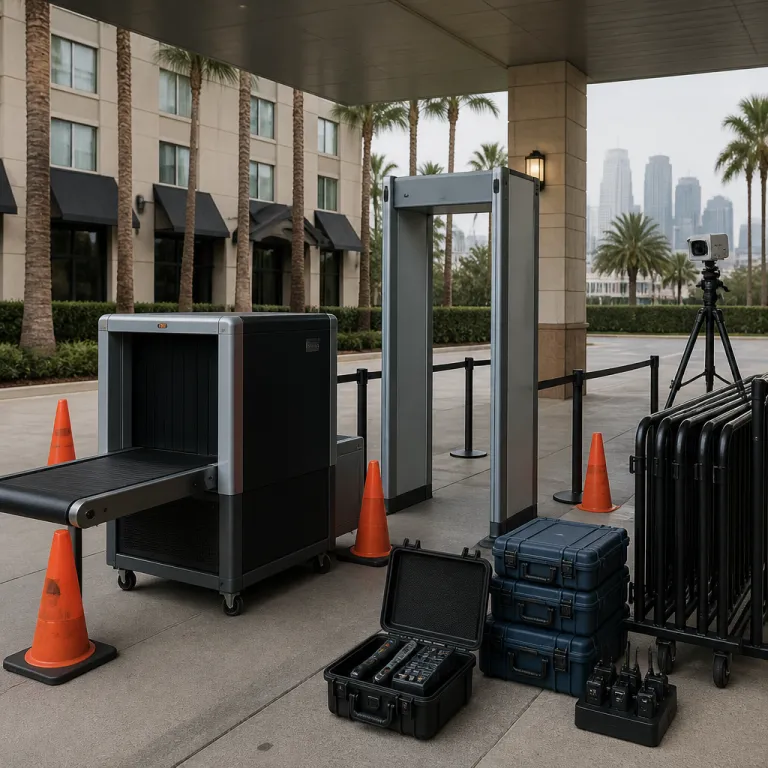
Security services providers such as North Star Security Solutions, Phalanx Security Group, and Security Base Group increasingly integrate surveillance cameras, metal detectors, and encrypted communication devices into their guard services. For insurers and in house legal counsel, the key question is whether the event manager can evidence a coherent governance framework that links security officer procedures, cyber incident playbooks, and contractual duties to protect guest data. That is where on site guarding as the backbone of integrated security in hospitality and travel, as analysed in this dedicated piece on integrated guarding strategies, becomes directly relevant to underwriting and claims defensibility.
In practice, allied teams of security guards and IT specialists must jointly manage access control for staff entrances, loading docks, and VIP corridors during events. A single compromised badge or poorly supervised security officer can open a path not only to physical intrusion but also to network access, especially where back of house systems are reachable from shared terminals. Industry loss examples show that stolen credentials used at shared terminals have led to both property damage and data breach notifications in hospitality environments. Risk managers should therefore require that private security contracts in Los Angeles explicitly address cyber liaison roles, logging of access control events, and escalation thresholds for suspected digital compromise.
High stakes special events and the liability map for hospitality operators
Large scale special events in Los Angeles, from film premieres to global brand conferences, create a dense web of liability across owners, operators, and security providers. A hotel that transforms into an arena style venue for a one night event inherits security challenges that differ radically from its usual residential security profile. Underwriters and legal advisers must therefore map how responsibility is allocated between the venue, the event manager, and any external guard company or executive protection team.
Case experience from California shows that disputes often arise around the precise scope of security services and the adequacy of guard coverage in high traffic zones. When an incident occurs near a secondary entrance or a temporary structure, plaintiffs frequently argue that the security officer deployment plan was insufficient, while the guard company may claim that the event manager restricted staffing levels for budget reasons. The analysis in this article on elevating event guard security for high stakes operations underlines how critical it is to document these decisions in advance.
A widely discussed illustration is the crowd surge at the Astroworld Festival in Houston in 2021, which, although outside Los Angeles, has strongly influenced event security thinking in California. Investigations highlighted questions about staffing levels, emergency access routes, and coordination between private security, venue operators, and public agencies. For risk managers in Los Angeles, the lesson is clear: a robust event security framework should include scenario based staffing models, clear definitions of high risk zones, and explicit triggers for reinforcing guards or officers when crowd density rises. Contracts with private security providers, including large players such as Allied Universal or more specialised firms, should specify how executive protection for VIP guests interacts with general crowd management duties. Without that clarity, even a well trained security guard team can face conflicting instructions between protecting a single high profile guest and maintaining safe evacuation routes for thousands of attendees.
Choosing and governing security guard companies in Los Angeles hospitality
Selecting a guard company for event security in Los Angeles is no longer a simple procurement exercise based on hourly rates. For hospitality and travel operators, the choice of security guards directly influences guest perception, regulatory compliance, and the insurability of the entire event. Risk managers should therefore evaluate providers on governance maturity, incident reporting discipline, and their ability to integrate with venue specific emergency plans.
Leading event security providers in Los Angeles, such as North Star Security Solutions, Phalanx Security Group, and Security Base Group, typically offer both armed and unarmed officers for events and residential environments. When assessing these security professionals, senior leadership teams should request evidence of training in crowd psychology, hospitality etiquette, and data protection awareness, not only in physical intervention techniques. A provider that treats events security as a specialised discipline rather than a generic extension of residential security will usually deliver more consistent protection for high profile hospitality venues. Contract structures should distinguish between baseline guard services, such as static posts and access control, and higher value services like executive protection or event manager liaison roles. Insurers and legal teams should insist on clear reporting lines so that every security officer on site knows who can authorise changes in coverage, lockdowns, or cooperation with law enforcement. When these governance elements are in place, the guard company becomes a strategic partner in risk mitigation rather than a commoditised supplier of short term jobs for temporary guards.
Embedding security by design into hospitality event planning in Los Angeles
Security by design means integrating protection thinking into every stage of event planning, from concept to post event assessment. In the Los Angeles hospitality ecosystem, that approach requires early collaboration between the event manager, the venue operations team, the security officer in charge, and the insurer or broker. When these actors meet only days before a major event, the result is usually fragmented coverage and reactive decision making.
A structured planning cycle for events in California should include pre event risk workshops, tabletop exercises, and joint walk throughs of the venue with security guards and technical staff. These sessions allow teams to test access control flows, identify blind spots for surveillance cameras, and define how executive protection details will move VIPs without disrupting general crowd movement. A concise guest guidance package should also be prepared, covering arrival times, security screening expectations, prohibited items, and how to report suspicious activities through venue apps or hotlines, so that staff and visitors receive consistent, practical instructions.
Hospitality brands that operate both event spaces and residential towers in Los Angeles must also manage the interface between public events and private residential security. A gala in a shared lobby, for example, can expose residents to noise, crowding, and elevated security challenges if guard services are not calibrated to protect both populations. Embedding security by design into contracts, marketing materials, and staff training helps ensure that every officer, from front of house guard to back of house supervisor, understands their role in preserving both safety and guest experience.
Insurance, legal frameworks, and the evolving risk profile of event security in Los Angeles
Insurance and legal frameworks around event security in Los Angeles are evolving as incidents, claims, and regulatory expectations accumulate. For insurers, the combination of high value guests, dense crowds, and complex venues in California creates aggregation risks that require precise underwriting of security services and guard company capabilities. Legal advisers supporting hospitality groups must therefore align contractual clauses on security guard performance, incident notification, and cooperation with investigations with the realities of modern events.
Recent trends in the Los Angeles market include increased use of AI enabled surveillance, closer collaboration with local authorities, and a shift toward non invasive security measures that respect guest privacy. These developments reshape how security officers, event managers, and executive protection teams collect and store data, which in turn affects liability for data breaches and privacy violations. For risk managers, a key task is to ensure that private security providers, including large actors such as Allied Universal and more boutique firms, operate under clear data governance rules when handling footage, access logs, or identification documents.
Several years ago, many hospitality operators treated events security as a peripheral function, often outsourced with minimal oversight. That approach is no longer defensible in a city like Los Angeles, where high profile events attract global media attention and sophisticated threat actors. As explored in this analysis of how European food safety traditions reshape hospitality risk through a security lens on hospitality risk culture, the most resilient organisations treat safety, security, and compliance as intertwined pillars of their brand promise.
Key statistics and operational benchmarks for event security in Los Angeles
- The Los Angeles Tourism & Convention Board reports that the city hosts thousands of meetings, conventions, and special events each year, illustrating the sustained demand for specialised event security services across hospitality and travel venues.
- City permitting data and industry surveys indicate that larger events in Los Angeles commonly deploy security teams ranging from a dozen to several dozen guards, which provides a useful staffing benchmark for risk managers planning coverage at comparable venues.
- High profile events in Los Angeles typically involve multi layer cooperation between private security officers, venue staff, and local law enforcement, a model that has become standard practice to manage crowd safety and emergency response.
- Industry observers note a growing use of AI supported surveillance tools in California event venues, reflecting a broader shift toward technology enabled monitoring that complements traditional guard services rather than replacing them.
FAQ about event security in Los Angeles hospitality and travel
What types of events in Los Angeles require structured security planning ?
Concerts, festivals, corporate events, private parties, and red carpet events in Los Angeles all require structured security planning when hosted in hospitality or travel related venues. Risk managers should treat any gathering with significant crowd density, VIP attendance, or alcohol service as a candidate for formal event security planning. Even smaller residential events in branded residences may need tailored residential security measures when high profile guests are involved.
How can a hospitality operator hire event security in Los Angeles ?
Hospitality operators can hire event security in Los Angeles by engaging licensed firms such as North Star Security Solutions, Phalanx Security Group, or Security Base Group. These providers offer security guards, officers, and specialised services that can be aligned with venue specific risk assessments and insurance requirements. Contracts should clearly define guard services scope, access control responsibilities, and coordination with the internal event manager.
What are the main cost drivers for event security at hospitality venues ?
The primary cost drivers for event security at hospitality venues in Los Angeles include event size, duration, risk profile, and the mix of services required. Deploying a larger number of security guards, adding executive protection for VIPs, or extending coverage to adjacent residential areas will increase overall cost. Use of advanced surveillance technologies and AI based monitoring can also influence pricing, although these tools may improve efficiency over time.
How should risk managers evaluate the adequacy of security coverage ?
Risk managers should evaluate the adequacy of security coverage by comparing planned guard numbers and officer roles against crowd estimates, venue layout, and identified security challenges. Benchmarks such as typical staffing levels for comparable events in Los Angeles provide a starting point, but high risk events may require more intensive coverage. Scenario testing, tabletop exercises, and post event reviews help refine these staffing models for future events.
What practical guidance should be given to guests attending secured events ?
Guests attending secured events in Los Angeles should receive clear guidance on when to arrive, what security checks to expect, and how to behave in crowded spaces. Simple, consistent messages shared through tickets, mobile apps, and on site signage about screening procedures, prohibited items, and how to report suspicious activities help align guest behaviour with security officer procedures and create a smoother, safer experience for all participants.