Hotel legionella testing protocol: beyond compliance to real risk control
Why a hotel legionella testing protocol must go beyond compliance
For a modern hotel, water is not just a utility line; it is a core part of the guest experience and a silent vector of legionella risk. When a hotel legionella testing protocol is built only around minimum regulations, the property accepts that the first sign of Legionnaires’ disease may be a guest in intensive care and a lawyer at the front desk. A risk manager who treats the building water system like a live organism to be mapped, monitored and controlled will usually prevent the outbreak, the claim and the reputational damage.
Health and safety consulting benchmarks now place legionella alongside pollution as a primary health exposure for hotels, because every large building contains complex water systems that can amplify bacteria. The context is simple and unforgiving: Legionella bacteria pose serious health risks in water systems, and hospitality facilities concentrate vulnerable guests, from older travelers to immunocompromised conference attendees. In this environment, a robust water management program is not a technical luxury but a duty of care that insurers, health department inspectors and courts increasingly expect as standard.
Regulators in many jurisdictions still focus on basic water safety rules, such as maintaining hot water above a minimum temperature and cold water below a maximum threshold, with periodic testing as a backstop. CDC guidance in the United States emphasises written water management plans and verification of control measures, while frameworks such as the UK Health and Safety Executive’s HSG274 treat legionella control as a continuous management system rather than a box-ticking exercise. Public health surveillance data from agencies such as CDC and ECDC show that reported Legionnaires’ disease cases have risen significantly over the past decade, and every cluster traced back to a hotel or similar facility becomes a case study in failed control measures and missing monitoring data; one widely cited example is the 2015 New York City outbreak linked to a hotel cooling tower, which resulted in multiple deaths, extensive remediation and substantial legal and reputational costs.
Designing a risk based water management program for hotels
A credible hotel legionella testing protocol starts with a structured risk assessment of every water system, not just the obvious cooling towers and spa pools. The assessment must map all premise plumbing, from the main incoming drinking water line to the furthest guestroom dead leg, and classify each segment by legionella risk based on temperature, stagnation and aerosol generation. Facility managers, as the on-site implementers, are the ones who translate this map into a living water management plan with clear control measures, monitoring points and escalation triggers.
High risk systems in hotels are well known: cooling towers, decorative fountains, hot tubs, misting features and any hot water loop with long pipe runs or low use rooms. Each of these systems can support legionella growth if temperature control fails or if disinfectant residuals decay, especially during low occupancy periods when building water turns over slowly. Health inspectors, acting as regulators, will focus on whether the hotel can show a documented program that identifies these risks, defines testing frequencies and proves that non-conformances triggered immediate corrective action.
Beyond the obvious plant rooms, the risk assessment must include laundry, kitchens, staff showers and back-of-house facilities where hot and cold water are used intensively but often monitored less. A practical example is a conference hotel that mothballs an entire floor during the shoulder season, leaving premise plumbing stagnant and creating ideal conditions for legionella growth when hot water is reheated without flushing. Consulting water quality experts increasingly recommend that hotels align their internal protocols with the structure of the UK HSG274 framework, even outside the UK, because it treats legionella management as a continuous cycle of assessment, control, monitoring and review. For a deeper view on how food safety thinking is reshaping similar programs, many risk leaders study hospitality food safety risk analysis case studies and then adapt the logic to building water, often using the same hazard analysis and critical control point style checklists to structure their water safety plans.
Operational testing, monitoring and temperature control that actually work
Once the risk assessment is complete, the hotel legionella testing protocol must translate into a weekly, quarterly and annual routine that operations teams can execute under pressure. Weekly tasks usually focus on temperature control checks at sentinel outlets, verifying that hot water reaches at least 60 °C at the calorifier and 50 °C at taps, while cold water stays below 20 °C to limit legionella growth. These simple readings, logged with calibrated thermometers, are the frontline control measures that prevent bacteria from colonising the water system between more complex testing rounds.
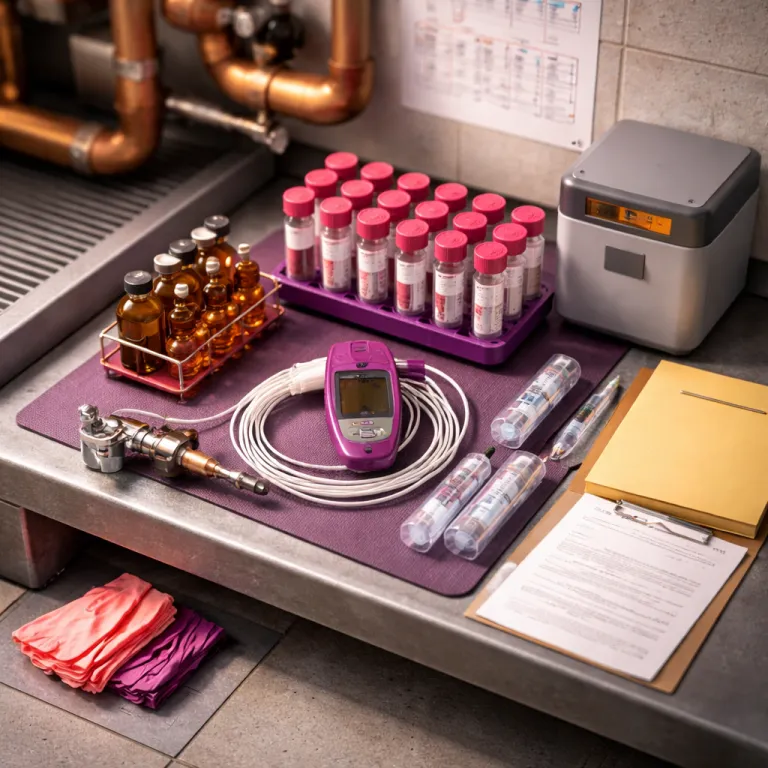
Quarterly, many hotels now schedule microbiological testing for legionella at representative points in their water systems, including cooling towers, spa pools and distal outlets in low use rooms. Routine water sampling should follow a strict chain of custody, with samples taken by trained staff or accredited partners and analysed by third party laboratories that understand building water dynamics. A typical chain-of-custody step-by-step process includes labelling each bottle with a unique ID, recording the sample point, date, time and sampler, sealing containers in a cooled transport box, and having both the sampler and laboratory sign the transfer form so that the integrity of the evidence is preserved; standard practice is to collect 1 litre per sample for culture-based analysis, keep samples at 2–8 °C, deliver them to the laboratory within 24 hours, and use recognised methods such as ISO 11731 culture or validated PCR assays, with clear documentation of whether rapid molecular tests are being used for screening or confirmation.
Annual reviews then step back to examine the entire water management program, from premise plumbing modifications to changes in occupancy patterns, and adjust the testing matrix so that monitoring remains aligned with real world risk rather than legacy pipe diagrams. Operationally, the most resilient hotels treat water management like fire safety: drills, logs and clear roles rather than a binder on a shelf. Facility managers coordinate with health departments, accredited laboratories and consulting firms to refine the testing schedule, while general managers ensure that budgets cover both routine monitoring and contingency disinfection equipment. To make this operational discipline easier to sustain, many teams use a simple internal checklist or template that lists each asset, its risk rating, required temperature checks, sampling frequency, responsible person and escalation steps, and then review that document at least annually.
Documentation, litigation resilience and the insurance conversation
From a legal and insurance perspective, the difference between a defensible hotel legionella testing protocol and a paper exercise is usually found in the documentation trail. When a guest develops Legionnaires’ disease and alleges exposure at a specific hotel, litigators and insurers will immediately request water system schematics, risk assessment reports, testing logs and evidence of corrective actions. A hotel that can produce calibrated instrument certificates, laboratory reports with intact chain of custody and signed records of temperature control checks stands in a far stronger position than one relying on verbal assurances from maintenance staff.
Health inspectors, acting as regulators, increasingly expect hotels to maintain digital records of water safety activities, including monitoring data, disinfection events and communications with the health department. For risk managers and legal teams, the objective is not just regulatory compliance but litigation resilience; documentation must show that the hotel applied recognised legionella control standards consistently, not sporadically before an audit. Insurers, especially those underwriting environmental and public health exposures, now differentiate between hotels that operate a mature water management system and those that treat legionella management as an afterthought.
In practice, this means aligning the water safety file with broader enterprise risk management and crisis response playbooks. The same governance discipline that protects a hotel from deepfake payment fraud, as illustrated in case studies on wire fraud at hotel finance desks, should apply to building water risks: clear roles, tested procedures and evidence that controls operated as designed. When a claim arises, the ability to show that facility managers, health inspectors and water quality experts worked together under a documented program can be the difference between a manageable settlement and a precedent-setting judgment that reshapes the portfolio’s risk profile; in several recent hotel-related cases, settlements reportedly reached seven figures once medical costs, legal fees and business interruption were fully accounted for.
The cost benefit case and seasonal risk scenarios for hotel water systems
For ownership and asset managers, the most persuasive argument for a robust hotel legionella testing protocol is often financial rather than technical. Typical settlements for a single confirmed Legionnaires’ disease case can range from hundreds of thousands to several million dollars, while a comprehensive water management program with regular testing, monitoring and disinfection usually costs a fraction of that per year. One prevented case can effectively pay for a decade of proactive legionella control, especially when reputational damage and lost future bookings are factored into the risk model; for example, a midscale city hotel that avoided a suspected outbreak through early detection and targeted disinfection reported only minor remediation costs compared with the projected revenue loss and legal exposure if guests had become ill.
Seasonal operations add another layer of complexity, because building water systems behave very differently during low occupancy or partial shutdowns. When wings are closed, rooms are taken out of service or cooling towers are idled, premise plumbing can stagnate, disinfectant levels can fall and temperature control can drift into the range that favours legionella growth. A resilient program therefore includes specific control measures for shutdown and restart, such as systematic flushing, shock disinfection and targeted testing before guests return to those parts of the hotel.
From a strategic risk management perspective, hotels that treat water safety as a continuous operational discipline rather than a compliance project tend to integrate it into broader health and safety culture. Facility managers schedule water testing alongside other preventive maintenance, general managers review water safety KPIs with the same seriousness as guest satisfaction scores, and insurers reward this maturity with more favourable terms. As one of the core reference materials in this field states without ambiguity: What is Legionella? A bacteria causing Legionnaires’ disease. Why test beyond compliance? To prevent outbreaks and legal issues. How often should testing occur? Regularly, as per risk assessment. Those three sentences, taken seriously, are the backbone of a hotel water safety strategy that prevents both disease and lawsuits, and they can be translated into a concise internal checklist or template that keeps the entire team focused on the essentials.
FAQ
What is legionella and why is it a concern for hotels ?
Legionella is a bacterium that thrives in man-made water systems and can cause Legionnaires’ disease when inhaled through contaminated aerosols. Hotels are particularly exposed because they operate complex hot and cold water networks, cooling towers, spas and decorative features that can all support legionella growth if temperature control and disinfection fail. For risk managers and legal teams, this makes legionella control a core part of health and safety governance, not a niche engineering issue.
How often should a hotel test its water for legionella ?
Testing frequency should be based on a formal risk assessment, but many experts recommend weekly temperature checks, quarterly microbiological testing at representative outlets and an annual full system review. High risk systems such as cooling towers, spa pools and low use guestroom lines may require more frequent monitoring, especially after shutdowns or major plumbing works. The key is to align testing with the actual behaviour of the building water system, rather than relying only on generic regulations.
Which parts of a hotel water system are usually highest risk ?
The highest legionella risk typically sits in systems that combine warm water, stagnation and aerosol generation, such as cooling towers, hot tubs, showers and decorative fountains. Long pipe runs to rarely used rooms, complex premise plumbing with dead legs and storage tanks with poor temperature control also create favourable conditions for legionella growth. A thorough mapping of the water systems is therefore essential before designing any hotel legionella testing protocol.
What documentation should a hotel keep to defend against legionella claims ?
Hotels should maintain a complete water safety file that includes the risk assessment, water system schematics, temperature logs, microbiological testing reports, calibration certificates for instruments and records of all corrective actions. Chain of custody documentation for samples, contracts with accredited laboratories and correspondence with the health department also strengthen the legal position. In litigation, the ability to show consistent, well documented legionella management is often as important as the test results themselves.
Who should be involved in designing and running the water management program ?
Effective programs usually involve facility managers as day-to-day implementers, supported by external water quality experts who advise on testing design and control measures. Health inspectors and health departments act as regulators and partners, ensuring that the hotel’s approach aligns with public health expectations and applicable regulations. Senior leadership, including the general manager and risk manager, must also engage, because budget, training and accountability decisions sit at their level.